
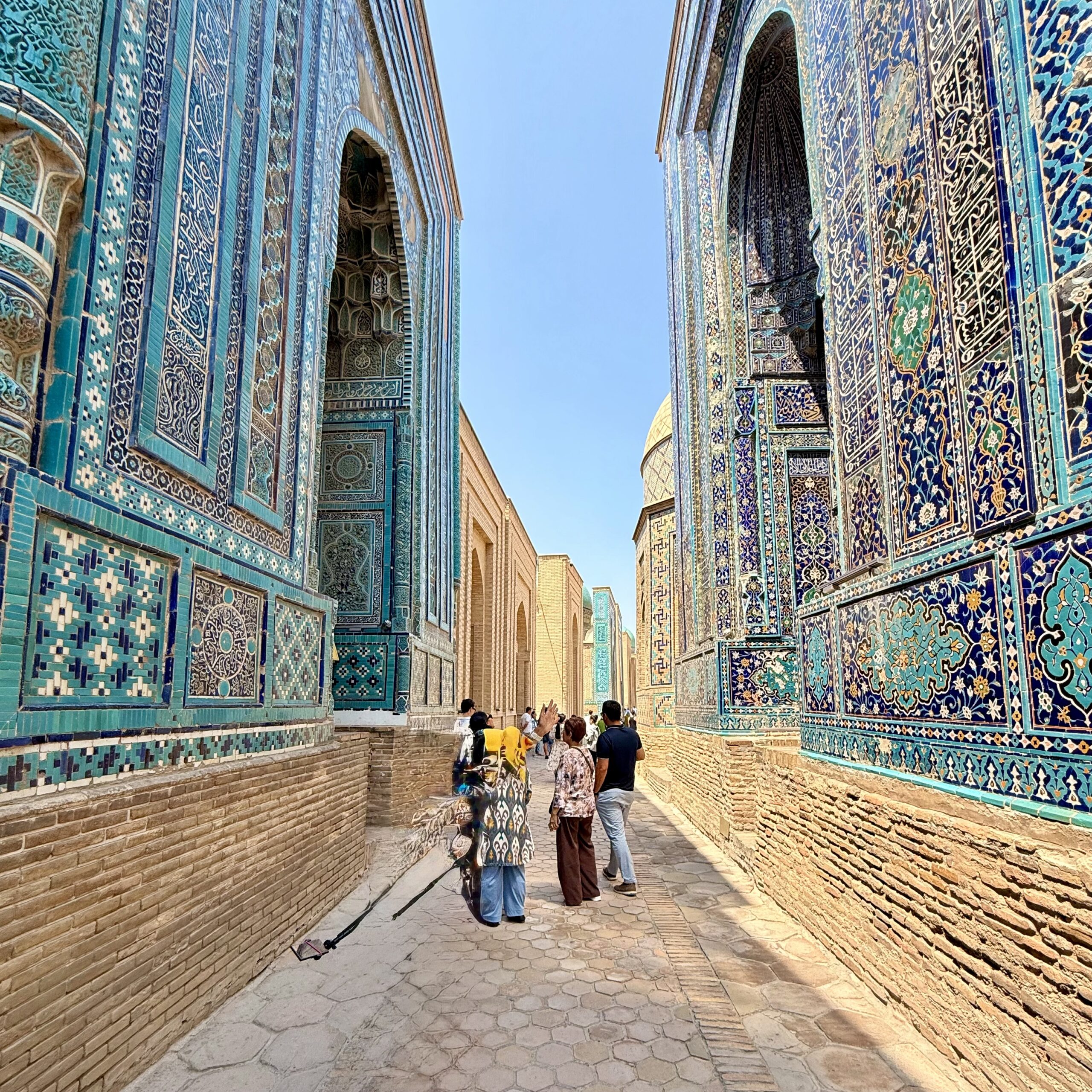
There are journeys you embark on because you are looking for something. And journeys that give you something you hadn’t even sought out. Uzbekistan was both.
I stood in Registan Square in Samarkand—and I was unprepared. Not for that blue. Not for that silence, even though a hundred people stood around me. Not for the fact that a square which was once the center of the world still feels that way today.
The Silk Road is not a place. It is an idea. Caravans traversing deserts, carrying spices, silk, and stories from one end of the world to the other. Today, the road is history. But the cities still stand. And Bukhara and Khiva impressed me the most.
In Bukhara, I drank tea and ate bread with an old man at a teahouse—right next to an 11th-century minaret that once served as a beacon for caravans. He spoke no German; I spoke no Uzbek. We understood each other anyway. That is what happens when you travel: you learn that language isn’t the most important thing. Bukhara is one of Central Asia’s best-preserved old towns: trading domes, the Ark Fortress, the Lyabi-Hauz pool with its ancient mulberry trees. History that feels as if it is still breathing.
Khiva was the most unusual and perhaps the most beautiful place. A walled city—the Itchan Kala—with over fifty historic monuments packed into a small area; no noise, no traffic. In the evening, once the tourists had left, the city belonged to itself again. I sat on a wall and looked out over the mud-brick houses. Somewhere, someone was playing an instrument whose name I do not know. That night, I understood why Khiva feels like it belongs to another era—because it does.
Rediscovering the Silk Road doesn’t mean looking up history in a book. It means taking your time. Sitting in a courtyard. Watching an artisan at work. Breathing in the scent of the bazaar. Understanding that the people who live here are not “somewhere far away.” They are neighbors—whose history is more intertwined with our own than most of us realize.
Ready for your own adventure? Get in touch.
Enquire now